
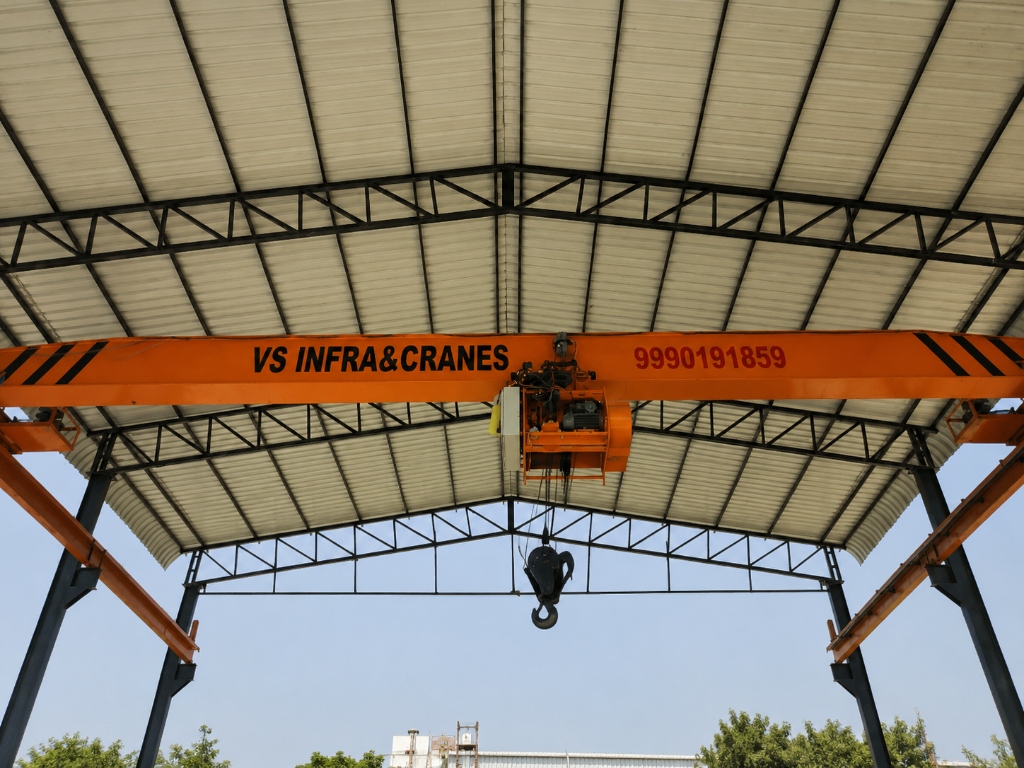
Struggling to decide which crane fits your facility? We break down the cost, clearance requirements, and capacity limits of single vs double girder overhead cranes.
Understanding the Basics
The choice between a single girder and a double girder EOT crane is one of the most fundamental decisions in material handling. Both designs offer unique advantages depending on your application.
Single Girder EOT Cranes
Single girder cranes feature one bridge beam. The hoist runs on the lower flange of this beam.
- Pros: More cost-effective, lighter wheel loads (saving money on runway structures), faster installation.
- Cons: Generally limited to 20 Ton capacity and 25m span. Lower maximum lift height.
Double Girder EOT Cranes
Double girder cranes utilize two bridge beams, with the hoist crab running on top of rails mounted on the girders.
- Pros: Can handle heavy capacities (up to 50+ Tons) and wide spans. Offers the maximum possible lift height since the hoist sits on top of the girders.
- Cons: More expensive, heavier, requires stronger building support structures.
Conclusion
If you need to lift under 20 tons in a standard workshop, a single girder is usually the most economical choice. For heavy-duty applications like steel plants, double girder is mandatory. Need help deciding? Our engineers are ready to assist.